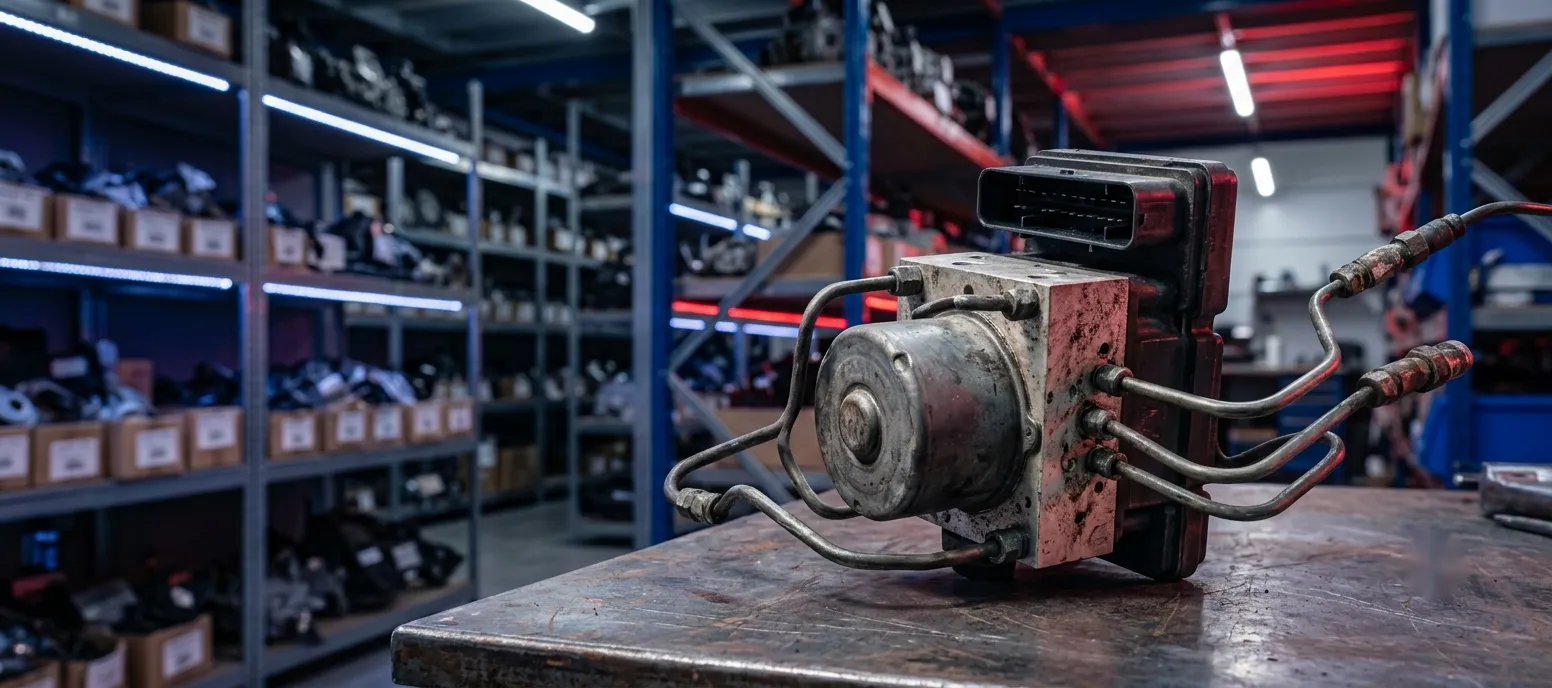
Used ABS Module for Sale – Bench-Tested OEM Units Matched to Your Vehicle
A casting number tells you what a module looks like, not what it is calibrated for. Every used ABS module for sale is bench-tested and verified against your VIN and Hollander interchange before shipping, including the software and housing. With over 3,000 tested units in stock, we cover vehicles from 1980 to 2026 across 50+ makes.
- VIN-matched OEM fitment
- Steering column inspected and tested
- No core charge
- 90-day warranty & fast shipping



Chassis and Drivetrain Parts That Work Alongside Your ABS
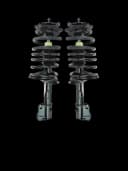
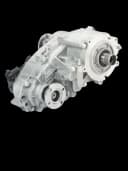
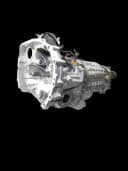
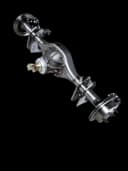
An ABS fault rarely lives in isolation. The instrument cluster often reads vehicle speed from the module, the axle carries the tone ring it listens to, and the steering gear feeds the stability system. Every part below is VIN-matched the same way.
Control Module, Pump or Sensor: Pinpointing What Actually Failed
ABS module is often used for three different components. Knowing which one has failed is the difference between a $50 repair and a $500 one.
Electronic Brake Control Module (EBCM)
The computer that reads wheel speed and commands the hydraulics. On many vehicles it bolts directly to the pump and sells as one assembly.
Hydraulic Control Unit and Pump
The valve body and motor that modulate brake pressure. A used ABS pump is the right fix when the motor or valves fail but the electronics test clean.
Wheel-Speed Sensor
A small sensor at each wheel. A failed sensor lights the ABS lamp just as a failed module does, and costs a fraction as much.
Five Symptoms and Three Checks Before You Replace the Module
Before you spend anything, run through this list. A surprising number of "bad ABS module" calls turn out to be something cheaper.
Symptoms
- ABS Light On: Often paired with the traction or stability-control lamp.
- Pedal Pulsing at Normal Stops: The pedal pulses under light braking, not just hard stops.
- Stability Control Switching Off: Traction or stability control disables itself.
- Speedometer Acting Up: On vehicles where the cluster reads speed from the module.
- Failed Safety Inspection: Tied to an illuminated ABS or ESC light.
Pre-Purchase Checks
- Scan the Trouble Codes: A wheel-speed sensor or wiring fault can trigger the ABS light without the module being at fault. Confirm the code first.
- Inspect Wiring and Connectors: Corrosion or a loose plug at the module can mimic a failed unit. A quick look may save you a replacement.
- Verify VIN Compatibility: Your replacement must match your VIN, brake configuration and trim. Our team confirms the correct OEM unit before you order.
Four Bench Tests Behind Every Used ABS Control Module
Every used ABS control module goes through checks specific to what an anti-lock system does, not a generic once-over. Two modules can share a casting and still run different software for different brake setups, wheel sizes, or trim levels. That's why we verify beyond the part number.
4-Channel Wheel-Speed Sensing [EXISTING]
Each wheel reads independently, not paired by axle, as modern stability control requires.
OEM Calibration ID [EXISTING]
The software ID stored inside the module is matched to your VIN, not just the stamp on the housing.
Accumulator Pressure [EXISTING]
The hydraulic accumulator must build and hold the correct pressure.
Pump Motor Load Test [EXISTING]
The motor is cycle-tested under load rather than checked for simple continuity.
None of this shows up when you compare part numbers alone; that's exactly why it matters.
Read Us Your VIN. We'll Confirm Fit in About Two Minutes.
Mon–Fri: 7:00 AM – 4:00 PM — US-based specialists
Call 1-800-606-1107Used ABS Module Price Against Dealer Replacement
A tested used OEM module runs $150 to $500 for most applications. A new part alone from a dealership costs $600 to $1,200, and a full dealer replacement with labor runs $700 to $1,500.
| Option | Typical Cost | What's Included | Core Charge | Warranty | Time Off the Road |
|---|---|---|---|---|---|
| Used OEM (us) | $150 – $500 | Part only, shipped free | None, you keep your old unit | 90 days | Dispatched in 3–7 business days, installs on arrival |
| New dealer part | $600 – $1,200 | Part alone, before labor | Often charged | Factory term | Days to weeks if part backordered |
| Full dealer replacement | $700 – $1,500 | Part plus labor | Often charged | Factory term | Days to weeks, plus shop labor scheduling |
Five Factors That Move Your ABS Module Quote
Make and Origin: European applications generally cost more than domestic ones.
Assembly Type: A standalone EBCM costs less than a combined pump-and-module assembly.
Model Year and ADAS: 2016-and-newer modules with ADAS tie-ins cost more than 2005–2012 units.
Donor Supply: Discontinued or low-volume applications carry a scarcity premium.
Post-Install Coding: If your vehicle needs coding, the shop bills that time separately.
Used OEM, Remanufactured or Refurbished: Weighing Downtime Against Cost
The right answer depends less on abstract quality and more on your constraints. If your vehicle can't be driven, most remanufactured ABS module programs are ruled out. They are almost always send-in services: you pull your unit, ship it out and wait a week or more. A used OEM unit ships from our stock and installs the day it arrives.
| Path | Downtime | Keep an Old Unit? | Road-Tested First? | Calibration Match | Best For |
|---|---|---|---|---|---|
| New (dealer) | Days to weeks | No — core charge | No | Often needs dealer programming | Late-model vehicles under factory warranty |
| Remanufactured | A week or more | No — bench only | Your original returned to you | Rare vehicles with no donor supply | Rare vehicles rebuilt with no donor supply |
| Refurbished | A week or more | No — bench only | Your original repaired | Owners who can park the car and wait | Owners who can park the car and wait |
| Used OEM (us) | Install time only | Yes | Yes | Matched to your VIN before it ships | Drivers who need the car back fast |
If your vehicle is genuinely rare, donor supply thins out fast. That includes low-production European models, older Jaguar and Saab platforms and some commercial vehicles. A rebuilt unit may be your only realistic path, and we'll tell you so rather than promise what we can't deliver.
Plug-and-Play or Coding Required? Checking Your Vehicle First
Likely plug-and-play:
Most 2005–2015 vehicles without adaptive cruise, lane keeping or automatic emergency braking are plug-and-play. That includes most Ford, Chevrolet, GMC, Dodge and RAM trucks and SUVs from that window. Expect a brake bleed (sometimes scan-tool assisted), a code clear and, on some models, a steering-angle relearn. None of that is programming in the coding sense.
Coding Likely Required:
- European Makes: BMW, Mercedes-Benz, Audi, Volkswagen, Volvo, Jaguar.
- 2016 and Newer: The module stores the VIN internally.
- ADAS Equipped: Adaptive cruise, lane keeping or automatic emergency braking.
- EV or Hybrid: Blended regenerative and friction braking.
Before your order ships, we verify whether your vehicle requires programming, coding or calibration, so you can plan the installation with confidence.
One Module, Six Safety Systems: What an ABS Failure Takes Offline
Electronic stability control has been federally required on nearly every new vehicle since the 2012 model year. On most cars, it lives inside the same box as the anti-lock brakes. A single failed module can quietly disable stability control, traction control, hill start assist and trailer sway control. On ADAS-equipped vehicles, it can also take down automatic emergency braking and adaptive cruise.
Your brakes still work. What disappears is control while stopping: on ice, in rain or midswerve. That correction is the entire reason the system exists.
How Modern Braking Is Rewriting ABS Module Fitment
The Module Does More
A 2008 module ran anti-lock braking and traction control. Its 2022 equivalent also manages stability control, hill start assist, trailer sway, adaptive cruise and emergency braking.
More Features, Narrower Fitment
Each part family now holds more calibration variants, and most vehicles built after roughly 2016 need post-install coding.
Software Before Hardware
Check your VIN for an open recall or software campaign first. Some faults now resolve with an update, not a replacement.
Sealed EV and Hybrid Units
These systems combine the master cylinder, electronic booster and control module in one sealed unit, replaced as a single assembly.
Frequently Searched ABS Module Applications
These are among the most searched ABS module applications in the US. We confirm availability for your exact trim by VIN.
2013–2014 Honda Accord
One of the most searched sedan ABS modules. Calibration varies by trim and brake package.
2014–2016 RAM 1500
High-demand truck units, matched by 2WD or 4WD configuration.
2015 Jeep Wrangler
Matched by two-door or four-door body and axle package.
Chevrolet and GMC Trucks
EBCM units for Silverado and Sierra, typically plug-and-play through 2015.
Part or Software? Call With Your VIN Before You Spend a Dollar
We'll check for open recalls and software campaigns and help you rule out a sensor fault first.
Call 1-800-606-1107Four Conditions Every ABS Module Meets Before Dispatch
Clean-Title Donor
Low-mileage US salvage only. No flood, no fire, no unknown history.
Interchange Confirmed
Checked against Hollander interchange and the confirmed OEM part number before it's listed.
Proven Twice
Road-driven in a working donor vehicle, then bench-scanned for stored hard codes and validated for pump function.
You Risk Nothing
90-day parts warranty, no core charge and free shipping. You also keep the unit you pulled out.
From VIN Check to Installed Module in Three Steps
Send Your VIN
Use the form above or call 1-800-606-1107 with your year, make and model.
We Verify and Quote
A specialist confirms interchange, calibration ID and any coding needs. You receive a delivered price, typically within one business hour.
Your Module Ships Free
It's dispatched within 3-7 business days of payment clearing, with tracking issued the day it ships.
Shipping, Warranty and Returns on Every ABS Module
Free Nationwide Shipping
Included in every quote. We do not ship to Alaska, Hawaii or outside the United States.
90-Day Parts Warranty
Covers internal failure for 90 days from delivery. Labor, improper installation and consequential damage are not covered.
Filing a Claim
Send a diagnostic report, an installation report from a licensed shop and a photo or video of the fault.
Wrong-Part Orders
Returns or cancellations because the wrong part was ordered may carry a 25% restocking fee. VIN matching is how we help you avoid it.
Your VIN, a Verified Module, One Firm Price
Share your VIN and a specialist will confirm fit, flag any coding needs and quote one firm, delivered price, usually within one business hour.
Speak with a Specialist: 1-800-606-1107Most tested used OEM modules run $150 to $500, against $600 to $1,200 for a new dealer part before labor. European, ADAS-equipped, and combined pump-and-module units sit at the higher end.
Most 2005 to 2015 domestic vehicles without ADAS are plug-and-play after a brake bleed. European makes, 2016-and-newer models, and ADAS-equipped vehicles often need coding. We confirm this before your module ships.
Yes, when it's verified properly. Every unit is road-driven in its donor, bench-scanned for hard codes, pump-tested and matched to your calibration ID, then backed by a 90-day warranty.
A used module is the original factory unit, shipped from stock so your vehicle moves the day it arrives. Remanufactured modules are usually send-in repairs that keep your car parked a week or more.
Yes. Your 17-digit VIN lets us match the Hollander interchange and OEM calibration ID, not just the casting number. It's the most reliable way to confirm fit before you pay.
Yes. In states that inspect safety equipment, an illuminated ABS or stability-control light is a common failure point. Confirm the fault code first, since a wheel-speed sensor can trigger the same light.
Share your VIN, and a specialist will confirm fit, flag any coding needs, and quote one firm, delivered price, usually within one business hour.