2011 Ford F150 rear differential for sale
This was one of Ford's biggest sales years, and plenty of these trucks are past 150,000 miles. They came with several gear ratios, so check the axle code on your door sticker before ordering.
A 3.55 and a 3.73 rear axle can look identical on the shelf. Put the wrong one in and you’ll hear about it within a mile. We sell tested OEM units, including every Used Differential for Sale in California on this page, matched to your axle code and VIN. Every unit ships free and carries a 90-day warranty.



This was one of Ford's biggest sales years, and plenty of these trucks are past 150,000 miles. They came with several gear ratios, so check the axle code on your door sticker before ordering.
Half-ton Silverados of this era often start to whine as the ring and pinion wear. Your glovebox sticker tells us the exact ratio and whether you have the G80 locker.
We stock other years too. The axle code on the door sticker is all we need to start.
Same story. The RPO code in your glovebox gives us the ratio.
The Sierra shares its rear axles with the Silverado, so the same codes apply.
Popular with fleets and tow rigs across the Central Valley. Ram offered several ratios, so the VIN check matters here.
TRD Off-Road models have an electric rear locker. Standard models don't. We'll confirm which one you have.
Rubicon axles have lockers and other trims don't, and off-road damage is the usual reason owners call.
A whine or howl that rises with speed is the classic sign of worn ring and pinion gears or bad bearings. It often gets louder on and off the gas.
Too much slack in the gears, or a worn U-joint, can cause a hard clunk from the back of the truck.
Worn pinion bearings or a damaged carrier can shake the whole truck.
Look for wet spots around the cover or where the driveshaft enters. A leak left alone will cook the gears.
Limited-slip units chatter when the clutches wear or the fluid lacks friction modifier. Sometimes a fluid change fixes it.
Not sure what you're hearing? Call us. We'll help you work out whether you need a full differential or just a bearing job.
Look at the sticker on the driver's door jamb. The axle code (labeled "AX" on many models) stands for your gear ratio and whether you have a limited-slip unit. Ordering a 2011 Ford F150 rear differential for sale? That code is the first thing we'll ask for.
Open the glovebox and find the white Service Parts Identification sticker. Three-character RPO codes such as GU6 (3.42), GU5 (3.23) or GT4 (3.73) give the ratio. G80 means you have a locking rear differential. This is how we match every 2008 Chevy Silverado rear differential for sale.
Send us your 17-digit VIN. We'll decode it and confirm the ratio and carrier type for you.
Match the ratio and the truck drives like it did from the factory. Miss it and the speedometer reads wrong, shifts feel off, and on 4x4s the front and rear axles fight each other.
The type matters when you buy. A locker won't drop into a truck built for an open unit without wiring and parts changes. That goes for front axles too, so if you need a used front differential for sale for a 4x4, we'll confirm the carrier type and ratio against the rear before it ships.
Maintenance tip: Most differentials use 75W-90 or 80W-90 gear oil, and limited-slip units often need a friction modifier added. Check the level at every other oil change. Low or burnt oil is the fastest way to ruin a set of gears.
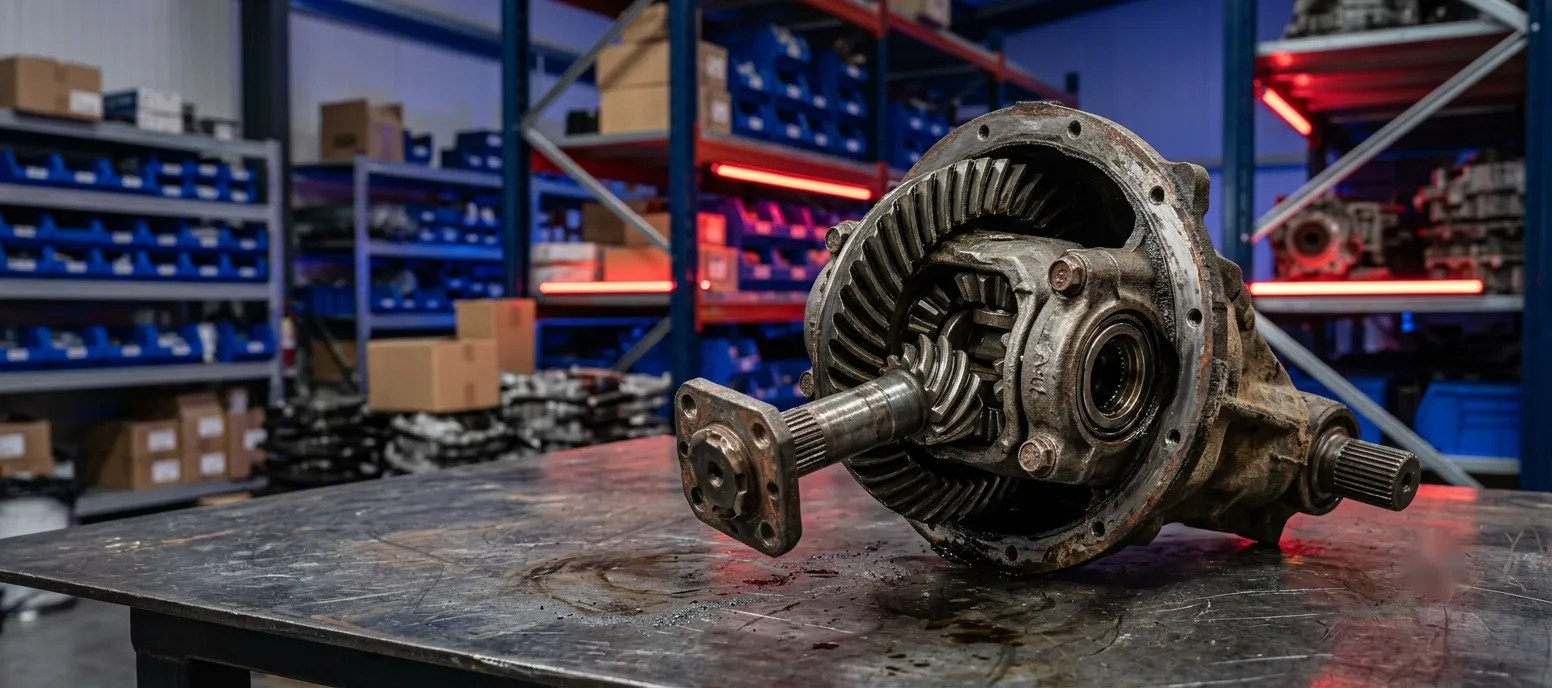
Most daily drivers use an open differential. It lets the left and right wheels turn at different speeds in a corner, which keeps tires from scrubbing. The catch: when one wheel loses grip in mud or sand, most of the power goes to that spinning wheel and the truck goes nowhere.
A locking differential fixes that by forcing both wheels to turn at the same speed when it's engaged. With the locker off, the truck drives like any other. Wrangler Rubicons and Tacoma TRD Off-Road models let you switch it on with a button. Some GM trucks use an automatic G80 locker that engages on its own.
Limited-slip units sit in between, using clutches to send some power to the wheel with grip.
Sacramento, Roseville, Redding, Chico
San Francisco, San Jose, Oakland, Monterey
Fresno, Bakersfield, Modesto, Stockton
Los Angeles, San Diego, Anaheim, Riverside
Looking for a used differential in Los Angeles? It usually reaches LA shops in two or three business days, with no shipping bill attached.
From our Rancho Cordova yard. We match every unit to your gear ratio before it ships, and shipping is free anywhere in the state. Each one has a 90-day warranty.
The part is usually the biggest piece. Our used rear differentials run $750 to $2,250, for most trucks, and shipping is free. Labor depends on the vehicle, so get an install quote from your shop.
A whining or howling noise that changes with speed, a clunk when shifting into gear, vibration, and gear oil leaks. Chatter in turns is common on worn limited-slip units.
You don't need a yard down the street. If you're searching for a used differential near me anywhere in California, we deliver in one to three business days with free shipping.
Yes. Our Rancho Cordova yard is about 15 miles east of downtown Sacramento. Call ahead so your unit is ready.
Yes. We stock used front differentials for most 4x4 trucks and SUVs. We match the ratio to your rear axle so the two work together.
A wrong ratio throws off the speedometer and shift points. On a 4x4, a front and rear mismatch makes the axles fight, which can damage the transfer case.
Usually a 75W-90 or 80W-90 gear oil. Limited-slip units often need a friction modifier too. Your owner's manual lists the exact spec.
It can. Mismatched ratios strain the transfer case and wear out tires and gears early. That's why we check the ratio, carrier type and VIN before shipping.
Every differential we sell carries a 90-day warranty.
Send us your VIN or axle code. We'll confirm the ratio, check stock in Rancho Cordova and give you a delivery date. Shipping's on us.